

Blogs
5 Common Childhood Heart Defects Every Parent Should Know AboutBy RCHI 29 Jul 2020
Here’s a handy guide on common pediatric cardiac problems
Whether you’re expecting a baby, or have a little one in tow, it’s likely that your child’s heart has been a topic of discussion at some point along the road. Perhaps at your first ultrasound, where the faint flicker on the screen signified a magical human life, or at your anomaly scan, where the flicker, now a pulsating ovoid, sat pretty in your baby’s now-well-formed body. With 1% of babies born with heart defects, it’s important to have a basic understanding of how cardiac anomalies could affect your child, should they occur.
5 common childhood heart defects
Structural malformations of the heart or blood vessels can give rise to congenital heart disease. Once considered beyond the purview of modern medical science, recent advances in research have made it possible to diagnose and treat congenital heart disease through surgery and heart catheterization. In this guide, we spotlight 5 common conditions and their corresponding treatments, to help you learn how pediatric heart defects can be addressed, corrected, and managed.
Ventricular septal defect
As the most common heart defect (20% of total), VSDs are small to large openings situated between the lower chambers of the heart. Besides a heart murmur, they may otherwise present a few other symptoms. Larger openings run the risk of developing into congestive heart failure, due to an overabundance of blood flow to the lungs from the left ventricle. Symptoms include breathing quickly, having a high heart rate, excessive sweating and challenges with weight gain.
Intervention
A wait-and-watch approach is usually adopted for babies with VSDs. If heart failure is preempted, a surgery to close the hole(s) may be advised. Such a surgery (for larger holes) is usually conducted within the first six months of a child’s life. Babies who are treated generally have a positive outcome and require little follow-up treatment.Atrial septal defect
An opening between the upper chambers of the heart, along the atria, is known as an atrial septal defect; a common congenital cardiac defect in kids. In general, ASD is an asymptomatic condition but may require treatment if it does not resolve on its own.
Intervention
There are several treatment lines for ASD, depending on its type: interventional cardiac catheterization is generally recommended for secundum ASD, while primum ASD, sinus venosus ASD and coronary sinus ASD are addressable without surgery. Surgery is usually a one-time occurrence.Tetralogy of Fallot
Usually diagnosed in utero, or soon after birth, Tetralogy of Fallot (TOF) is a common cardiac abnormality that involves the misorientation of the ventricular septum, and resultantly, an opening between the lower heart chambers. Blood flow from the right ventricle can be obstructed as a result of the condition, causing thickened heart muscle in the right ventricle.
Intervention
The speed and nature of intervention rests on the seriousness of the defect and the degree of obstruction. All cases of TOF warrant surgical intervention. While newborn babies may be given cardiac catheterization, older infants may have a tube surgically inserted between the aorta and the right pulmonary artery to allow for blood to return from the aorta to the lungs. Parents of babies and children with TOF must be vigilant about long-term follow-ups, and keep up to date with periodic treatments and valve replacements.Single ventricle defects
This group of conditions pertains to congenital malformations that cause only one of the two ventricles to be fully functional. Single ventricle defects can cause reduced oxygen levels, skin discoloration or ‘blueness’, or cyanosis.
Intervention
This condition warrants several surgeries to redirect deoxygenated blood straight to the lungs. Thanks to medical advances, over 85% of babies with such defects make it past the age of 4-6. It is believed that almost all children with one ventricle will eventually require mechanical apparatus or a transplant for the heart.Pulmonary valve stenosis
This group of congenital heart diseases points to an obstruction of blood flow between the right ventricle and the lungs. The condition usually presents a heart murmur, which is often a helpful clue for a pediatrician to order a confirmatory echocardiogram. While some cases are asymptomatic, increased obstruction could lead to an overworked and inordinately thickened ventricular muscle.
Intervention
A balloon angioplasty routine is usually the preferred means of surgery for pulmonary valve stenosis, although the suggested treatment hinges on the location and severity of the obstruction.
Taking heart in Rainbow Children’s Heart Institute
Rainbow Children’s Heart Institute is celebrated among India’s most innovative pediatric cardiac hospitals and has continually been rated the top heart hospital in Hyderabad. If your child has been diagnosed with a heart defect, our specialists can help you navigate the path to recovery and give your child the best chance at life.
Looking for a top heart hospital in Hyderabad? Click here to book an appointment with a children’s cardiologist near you.
<Recent Blogs

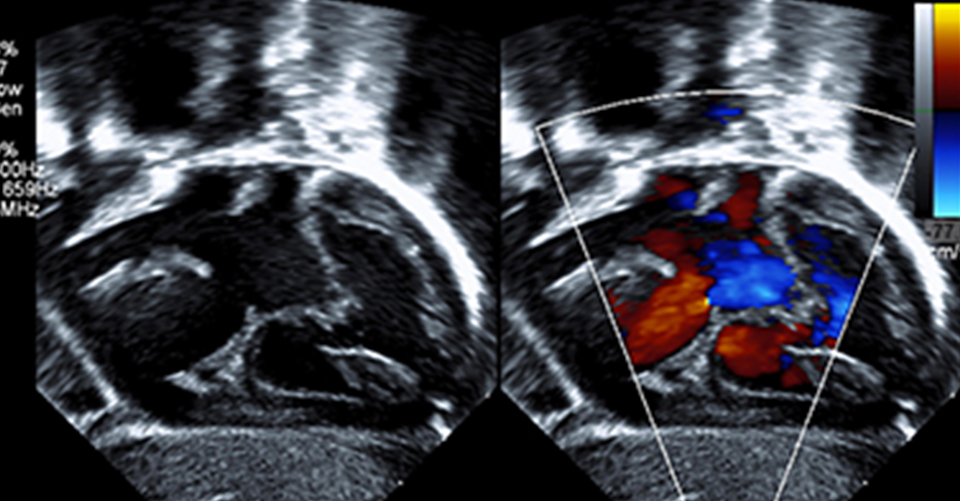
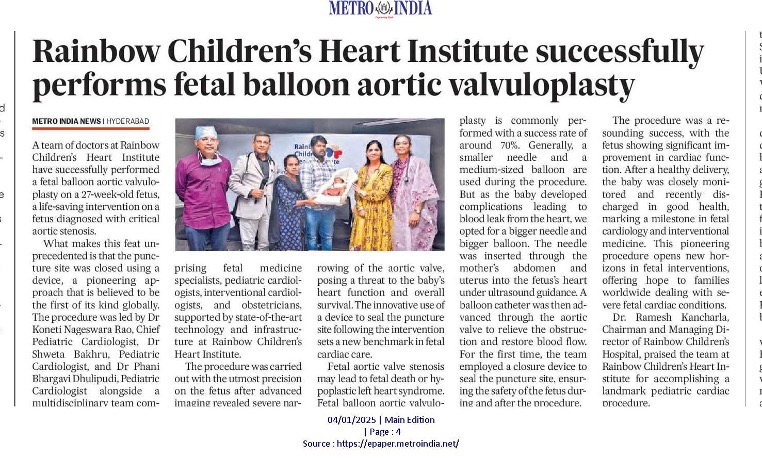
Introduction to Fetal Intervention
Fetal intervention is the process of performing surgery on a fetus (unborn baby) in the uterus. This...
By RCHI 02 Mar 2021
TOF or Tetralogy of Fallot
Tetralogy of Fallot is a condition when there are four consecutive issues with the heart. It is a ve...
By RCHI 02 Mar 2021
ASO or Arterial switch procedure
The ever rising pollution levels and changes in our lifestyle have led to an increase in heart-relat...
By RCHI 02 Mar 2021
Atrial Septal Defect in Children
The atrial septum is a wall of muscles that separates the left and the right atria, which are the tw...
By RCHI 04 Feb 2021
Chest pain in children
There can be various causes of chest pain in children. Almost all structures in the chest, including...
By RCHI 04 Feb 2021
All you need to know about Fetal Echocardiography, its conditions and treatments
A Fetal Echocardiography, commonly known as an ‘Echo’, is a test to examine and check the health of...
By RCHI 04 Feb 2021
Our Doctor

Dr. Koneti Nageswara Rao
Chief Pediatric Cardiologist Pediatric Cardiology
English, Telugu Banjara Hills, Road No 10

Dr. Shweta Bakhru
Senior Consultant Pediatric Cardiology
English, Hindi, Marathi Banjara Hills, Road No 10

Dr. D. Sri Phani Bhargavi
Consultant Pediatric Cardiology
English, Telugu Banjara Hills, Road No 10 Kondapur

Dr. Chauhan Abhinavsingh Abhimanyusingh
Consultant Pediatric Cardiac Surgeon Cardiothoracic Surgery
English, Hindi Banjara Hills, Road No 10

Dr. Yogesh Bakhru
Paediatric Anaesthesiologist Anesthesia
English, Hindi Banjara Hills, Road No 10

Dr. Konda Ramakrishna
Pediatric Cardiac Intensivist Intensive Care Unit
English, Hindi Banjara Hills, Road No 10

Dr. Krishnan Ganapathy Subramaniam
Director - Pediatric cardiothoracic surgery Pediatric Cardiology
English, Hindi, Tamil, Telugu Heart Institute, Banjara Rd 10

Dr. Shiva Rubini Tambirajoo's
Director - Clinical Associate Pediatric Cardiology
English, Malayalam, Tamil Heart Institute, Banjara Rd 10
Articles







Copyright © 2026. All Right Reserved by Rainbow Specialty Hospitals Private Limited.


